Seeds For Snack

Personally, snacks have been one of the most difficult challenges in changing my lifestyle. I can swing a smoothie for breakfast, salad for lunch, and let Orlando worry about dinner. That’s easy. But what do I do when its 5pm and i’m stuck in traffic and I know I’m not going to have dinner until at least 7pm. I’ll tell you what happens to me. First I feel the hunger…then I realize how long its going to be before I eat again…then I feel more hunger… then I see the bumper to bumper traffic in front of me…then I start thinking of bad food. Junk food. Fast food. Easy food. Anything I used to eat that would satisfy my current situation. By the time I get home and have been hungry for over an hour, I will eat almost anything I find. That’s not a good place to be. It leads to eating things you want to avoid and then later feeling guilty about it.

The solutions are slim to be completely honest!!!! But the key is to always be prepared and avoid getting to the point where you are starving.

I have done my homework, and have found that the easiest, cleanest, and most practical solution is to always have seeds and/or nuts in your office, purse, briefcase, or whatever it is you transport with you. You can prepackage them in little ziplock bags and take one every day with you.

Alton Brown once said you should have an ounce of raw almonds every single day.

NOTE: These are high-fat snacks, and although I promote eating whole foods that are high in good fats, moderation is the key to a healthy lifestyle! So govern yourself accordingly 🙂

There are all types of seeds you can find that are good for you:

  • Sunflower seeds- my favorite (unsalted…sorry)
  • hemp seeds
  • chia seeds
  • pumpkin seeds

Some good benefits of Seeds:

  1. Seeds contain iron and zinc. In fact, one ounce of pumpkin seeds contains almost twice as much iron as three ounces of skinless chicken breast!!!!
  2. They are also an excellent source of fiber and protein and Vitamin E.
  3. Sesame Seeds in particular are a good source of the bone-building mineral calcium.

Nuts are also great for you:

  • Raw almonds
  • Pistachios
  • Cashews

The reason I choose raw almonds is because almonds can lose up to 15 percent of their own healthy oils, according to Dr. Mehmet Oz. Also, when roasted at high temperatures, chemicals can be formed in the the almonds that promote aging. Of course, roasted almonds are a better choice than a bag of chips, so we must take everything with a grain of salt!!! So when you can, buy raw.

Benefits of Nuts as described by Mayo Clinic:

  • unsaturated fats. It’s not entirely clear why, but it’s thought that the “good” fats in nuts — both monounsaturated and polyunsaturated fats — lower bad cholesterol levels.
  • Omega-3 fatty acids. Many nuts are also rich in omega-3 fatty acids. Omega-3s are a healthy form of fatty acids that seem to help your heart by, among other things, preventing dangerous heart rhythms that can lead to heart attacks. Omega-3 fatty acids are also found in many kinds of fish, but nuts are one of the best plant-based sources of omega-3 fatty acids.
  • Fiber. All nuts contain fiber, which helps lower your cholesterol. Fiber also makes you feel full, so you eat less. Fiber is also thought to play a role in preventing diabetes.
  • Vitamin E. Vitamin E may help stop the development of plaques in your arteries, which can narrow them. Plaque development in your arteries can lead to chest pain, coronary artery disease or a heart attack.
  • Plant sterols. Some nuts contain plant sterols, a substance that can help lower your cholesterol. Plant sterols are often added to products like margarine and orange juice for additional health benefits, but sterols occur naturally in nuts.
  • L-arginine. Nuts are also a source of l-arginine, which is a substance that may help improve the health of your artery walls by making them more flexible and less prone to blood clots that can block blood flow.
  • For the full article visit: http://www.mayoclinic.com/health/nuts/HB00085

When it comes to seeds and nuts, I believe that in order to really get the most healthy fats and true benefits of them you need to buy them in their original state. So look at the ingredients of what you’re buying and make sure you’re buying them as single ingredients instead of disguised with a million different additives.

Fun Fact: Raw almonds are great for heartburn!!!! So for the pregnant ladies, try popping a fee raw almonds before TUMS and see how you feel!!


My Veggie Tray

I find roasting vegetables to be the most delicious method of cooking them. One of my favorite techniques is using whatever extra veggetables we have in our house, particularly the ones that are getting old, toss them in olive oil, add salt and pepper, and bake at 400 for 30-40 minutes. Almost all vegetables roast well. In fact, the only one I don’t roast is broccoli because it dries out too much.

The veggie tray is great for many reasons. First, it uses up some of the veggies that are going or will soon go bad. Second, it leaves a ton of leftovers that you can have for lunch (yes, I eat the veggies for lunch by themselves, they are that good) or feed the kids for dinner by simply reheating. Third, you can eat all you want…it’s all good for you–stuff your face!!! And finally, it is healthy, easy, and tastes awesome. Just toss, place on a cookie sheet, and close the oven door.

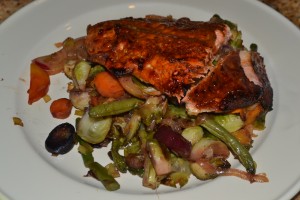
In this particular tray I used, Chopped carrots, green beans, a container of Brussel Sprouts (sliced), zucchini (rough chopped), and butternut squash (cubed in small pieces). I tossed them in a big bowl with olive oil, added salt and pepper, and roasted for about 40 minutes (start tasting them at 30 minutes for doneness). Seperately, I roasted some baby beets in aluminum foil in the same oven for the same 40 minutes.

After I had the veggies in the oven for about half an hour and they were almost done, I sauteed an onion, a bunch of asparagus (chopped in bite-sized pieces), and 2 leeks on a pan. I highly recommend that you make that as a side dish on its own one day. But for this dish, I love combining the onions and leeks with all the other veggies because it gives it more of a stir-fry flavor and texture. Cobine the veggies from the tray with the onions, leeks, and beets. And that is it!

Ingredients: Olive Oil, Salt, Pepper, Carrots, Beets, Green Beens, Asparagus, Leeks, Onion, Brussel Sprouts, Butternut Squash, Zuchinni (Healthy enough for you?)

There is really no limit to what you can do with this dish. You can choose to make the dish how I make it, or you can simplify your life and just roast the veggies. You don’t HAVE to roast the beets seperately or sautee onions and leeks. I just love it that way and don’t mind the extra steps. Feel free to add or subtract any veggie you want…you are only limited to your imagination and the produce section of your grocery store.

Along with the veggie tray, I made wild-caught salmon with an Asian 5 spice rub. This is super easy. Make sure to pull all the bones out of the Salmon (tweezers work like a charm). Put the rub on, add your favorite Asian sauce on the Salmon (they are often high in sugar, but only a little will crust on the salmon after Broiling). Then place it directly under the broiler for about 6-8 minutes. Remeber to use wild-caught salmon, it is MUCH better for you than the alternatives. Also remember that when using the broiler you should always leave the door open so you can watch the food. It can go from awesome to burnt in no time.

The meal was delicious and filling. We made so many vegetables that the next day we had leftovers for lunch. Caro gave the remaining salmon the following day to the kids with a sweet potato and they devoured it.

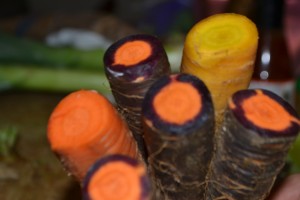
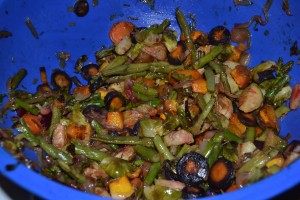
Below is a picture of the Heirloom carrots I used in this dish, the veggies being tossed together in the bowl, and the final product respectively.


Vegetable Medley


5 Quick tips to maximize your healthy eating this week!

Its happened to all of us. We read about eating healthy, we get inspired, we go to the grocery store and pile our grocery carts with all sorts of stuff we’re not familiar with, getting ready for our new life…and 2 weeks from now, we’re tossing rotten tomatoes, spoiled romaine lettuce, and the butternut squash is still sitting on the counter because we have no idea how to cut it open.

Eating healthy is not cheap and it becomes way more expensive and frustrating if we’re throwing our money in the trash with wasted food. Here are some tips to get you started this week, whether you’ve done your weekly groceries or not.

1. Don’t buy everything at once: You may read 3 different recipes you like and go out and buy all the ingredients for all of them. Chances are the way life is, things will come up during the week that will prevent you from making all the recipes you initially intended…and then you don’t know what to do with the ingredients. So they spoil. Avoid this common mistake. Buy ingredients for one recipe. Let’s say you want to make smoothies. Don’t buy kale, and collard greens and watercress. Simply buy a bunch of Kale. Buy some frozen berries, and check if you have any other fruits in your house that you could use, such as bananas or mangoes, or apples..etc.

2. Use your ingredients for different recipes. Start by trying the kale in the smoothies. You may also want to try Kale chips, or any other kale recipes to see if you like the vegetable cooked in different ways. Once you finished your bunch, you may opt to buy more for the next week or move on to your next option such as watercress or collard greens. Or if you bake sweet potatoes and have leftovers. In a couple of days make a sweet potato mash.

**If you have kids or babies, I’ve learned that there are a ton of ways to give them the same meal. If you make a soup for example, they can eat the soup the day you make it. Then with the left overs you can puree the soup and give it to them as a puree, and then another day make a puree and put it on a bed of germinated brown rice or quinoa. Or keep it as a soup and pour it over some zucchini pasta. Your options are endless!!!!

3. Eat what spoils quickest first. You’re dealing with perishables now, so its important you understand that there is timing involved when preparing your meals. If you buy apples, blueberries, butternut squash and mushrooms as an example…take the time to learn what spoils first. In this example, the blueberries and mushrooms will spoil the fastest so make sure you include them in your meals during the earlier part of the week. Squash will keep for a while so you can keep that for when you’re out of other vegetables.

4. Keep a running list on your refrigerator. Sometimes the fridge is so full of stuff, we forget what we have. Especially when you have a household full of people to feed and you routinely store leftovers. Whether its a magic board or a piece of paper taped to your refrigerator, As you start stacking the fridge with all the delicious things you bought, take the time to write the items down on the board or paper in a list format.

Example: 8/6/12

  • blueberries
  • strawberries
  • cantaloupe
  • pineapple
  • asparagus
  • sweet potatoes
  • kale
  • spinach

When you’re done with the blueberries scratch it off, etc.

Do the same with leftovers. If you make cabbage soup, Add it to your list with the date next to it.

This practice is excellent for choosing what you’re going to cook during the week, what snacks you have available and what leftovers you can take for lunch that week.

5. If its going bad, use it or freeze it right away. If you notice your bananas are turning black, you can either put them in your smoothie that morning or simply take the peel off, put them in a ziplock baggie and freeze them. You can use them later instead of throwing them away. Or if you use half a pear in your smoothie this morning and tomorrow the other half is sitting in the fridge turning brown, slice it up and put it in your salad.

Because you are committed to buying less boxed items and more perishable items, it is important that you learn to work with these kinds of foods. The goal is to buy less but use more.

Do you have any tips you can offer our community to maximize our healthy eating???? Please reply in the comment box and let us know!

Have a wonderful Monday!

Is Chocolate more than a guilty pleasure?

Cacao is the highest antioxidant food in the world, which was not known even 10 years ago. It is now known to be the number one longevity food in the world, with 15 times the antioxidants of wild blueberries. It is also the number one food for your heart; is the highest natural source of magnesium, the highest natural source of iron, manganese, and chromium of any major food group. It is also a tremendous source of phosphorus, zinc, and copper.

THE PROBLEM IS: the kind of chocolate that people eat is processed chocolate loaded with sugar, corn syrup, milk and anything else to sweeten it up.

Raw cacao is actually bitter. We’ve encouraged friends to try 85% percent chocolate bars and have a square for dessert after dinner each night. We started with 72% chocolate bars, worked our way up to 85% and now Orlando is into the 90% Lindt squares.

Another great way to get the anti-aging benefits of chocolate is to make a chocolate shake for breakfast, lunch, or even dinner.

Try this recipe:

  • 1-2 cups of unsweetened almond milk, goat milk, coconut milk
  • Raw cocoa powder 1-2 scoops (can be found at whole foods or online)
  • Stevia (nunaturals liquid alcohol)
  • Ice
  • Pinch of Celtic sea salt
  • 1-2 drop of cayenne extract
  • cinnamon
  • a dab of coconut oil

If you’re interested in Chocolate and its origins, see David Wolfe (expert in raw superfoods) below:

Fearless Friday: Turkey Burger and Sweet Potato Fries

So here’s the skinny on our Fearless Friday Burger and Fries.

We used

Organic turkey patties. Of course we could have made our own patties, but we did it on a Sunday and quite frankly, Orlando cooks every day and sometimes likes to take some shortcuts. What’s nice about those patties is that its a “single ingredient” item as we heavily promote. The ingredients are turkey and sea salt. None of those words we can’t pronounce!

Sargento swiss cheese. we’ve read it is the least processed of all the packaged cheeses….not sure how accurate this is. Need to research more and keep you posted! But we do the best we can with the information we have at hand. We understand that better options will come along and more knowledge may make us reevaluate some of our decisions at times…but that’s what this journey is all about!

Mushrooms and Onions. We’re simple burger kind of people. So piling on the greens becomes difficult in a situation like this because we want to enjoy the simplicity of a burger. But in an effort to include some veggies, we chose mushrooms which have anti-cancerous properties and onions. They are good for you and tasty and in our opinion work perfectly in  a burger.

Bacon. Oh yes we did. We used BACON! Some may ask why we didn’t use turkey bacon. Our research has shown us that turkey bacon really isn’t much better for us than regular bacon. In fact, regular bacon has more protein that turkey bacon, yet turkey bacon has high sodium and nitrates just like pork bacon that is equally as bad for you. The bottom line is that neither regular or turkey bacon should ever make its way into your daily diet. But if we’re going to cheat, we’ll use what we like best. We chopped up 3 slices of bacon for 6 burgers so as not to use excess.

Ezekiel Bun. Toasted I found that these buns were delicious but a little hard and dry. They definitely needed some ketchup or bbq sauce and Orlando and I took off the bottom bun and only had one slice with our burger. I don’t like thick burgers and that bun is pretty thick. I thought the one bun was perfect and my burger was delicious. And to our benefit, we had less carbs since we took off that bottom bun so I guess that was an added bonus.

Sweet Potato Fries. This was another item that we opted for convenience. It would’ve been better to make homemade sweet potato fries but sometimes you just want to be lazy. Of course they were baked and not fried, and it was the first time I’ve had any kind of fries in over a year!

So all in all the project was fun and the boys loved it. At the end of the day, we were an American family having a good ole’ burger with some fries…but those small but healthier choices we make along the way will have long lasting effects on our health. So cheers to Fearless Fridays!!!

P.S. We hope you enjoy our first cooking video!!! Let us know what you think!!!


Lentil Soup

You may have noticed…we’re big fans of Soup!! This is not a coincidence. Soups give you such an opportunity to Pile on the Greens and add goodness to your meal. It also allows us to make large portions which gives us leftovers for the kids and lunches.

I have to confess that before we started this journey I only ate 2 kinds of soup. Campbell’s cream of chicken and my mom’s chicken soup when I was sick. I didn’t even think I was a soup person. But all that has changed!!!!!

Now we have soup probably twice a week. Cabbage Soup is a weekly staple, and then one week we’ll make beet soup, and another week we’ll make lentil soup, so on and so forth.

We took this lentil soup from ALTON BROWN and Orlando put his spin on it. He’s actually tried several different variations, but each time he tries to pile on more greens!! This is his latest and in my opinion, most delicious, twist.
*Every item marked is an Orlando addition or substitution.

Ingredients:

  • 2 tablespoons olive oil
  • 1 cup finely chopped onion
  • I finely chopped leek*
  • 1/2 cup finely chopped carrot
  • 1/2 cup finely chopped celery
  • 2 teaspoons kosher salt
  • 1 pound lentils, picked and rinsed
  • 1 cup peeled and chopped tomatoes
  • 2 quarts vegetable broth
  • 1 tbsp freshly ground coriander
  • 1 tbsp teaspoon freshly ground toasted cumin
  • 1 tbsp teaspoon freshly ground Turmeric*
  • 1 cup of mushrooms*
  • 2 handfuls of spinach*
  • Chicken andouille sausage*

Directions:

Place the olive oil into a large 6-quart Dutch oven and set over medium heat. Once hot, add the onion, carrot, celery, leek and salt and sweat until the onions are translucent, approximately 6 to 7 minutes. Add the lentils, tomatoes,mushrooms, broth, coriander, cumin and turmeric and stir to combine. Increase the heat to high and bring just to a boil. Reduce the heat to low, cover and cook at a low simmer until the lentils are tender, approximately 50 to 55 minutes. 3 minutes before the timer ends, throw in the Spinach. It will wilt in 3 minutes so you really want to avoid putting it in until the end. Using a stick blender, puree to your preferred consistency. Serve immediately. Add cooked chicken andouille slices to the served plate.

A NOTE ON BLENDING: Consistency is a personal choice. Some people like the texture of the lentils, others like it thicker like a puree. I like the lentils, orlando likes the puree…therefore, we compromise. He puts half of the soup in our blender, blends and pours back into the dutch oven. That gives a little bit of both textures and it is DELICIOUS! But this is all a matter of personal preference.

Chicken Andouille: We slice the sausage down the middle and grill on our griddle. Then we slice it into small pieces and add to the meal. The soup can be eaten sans the sausage. We like it because it adds a spiciness to the soup that we enjoy and makes the soup more fillings. This too is a matter of personal preference.


About those Pesky Picky Eaters!

I had a conversation with a fellow healthy eater who is having a difficult time feeding her 3 year old. Most of us know that under the age of 2 you can usually get your kid to eat almost anything, but once the independence kicks in, so does the rejection of food. Some kids are always picky, but this pattern is the most common scenario.

That got me thinking and I felt compelled to write my thoughts on this because I feel quite strongly about it. I separated my thoughts into 3 main points.

1. We have a very simple but hard-line rule in my house:

YOU DON’T HAVE TO LIKE IT, AND YOU DON’T HAVE TO EAT IT, BUT YOU HAVE TO TRY IT. 

I have implemented this rule since my kids started eating solids, but I saw it emphasized in a book I read, Bringing Up Bebe, and realized how important this rule is. (I don’t agree with everything in this book by any stretch of the imagination, but on the issue of food…I think she’s makes good points)

This is powerful for a couple of reasons.

1. Tastebuds change. They change as we grow, as we explore, and as we age. We tend to attach one negative experience with food to a lifetime of choices. I don’t want my children to fall into that trap because it would really limit them from a culinary perspective.

I had an interesting experience with my 3 year old when he was sick. He got some sort of virus/cold and just wasn’t feeling well. I made him carrot/ginger/orange juice thinking it would boost his immune system and make him feel better. He tasted it and hated it so much that he actually started crying. Needless to say he didn’t drink the juice. 2 days later he was feeling better and I made him the juice again. He started crying when he saw it. He begged me not to give it to him. He told me that he had tried it once before and it was awful and he never wanted to taste it again. But my rules are my rules. I insisted he try it again. It took me some discussion, some crying, some time…but after about half an hour, I finally convinced him that he needed to try it once again. I reiterated my point…Orly, you don’t have to drink this whole cup, but you have to try it. If you don’t like it I promise you that I’ll give you some water to wash away the taste and you don’t have to drink anymore. He frowned, squinted his nose, and reluctantly put the cup to his mouth showing his disgust for the juice. All of a sudden, his frown turned into a smile and he started to laugh hysterically. I asked him why he was laughing and he responded…”Mami, you tricked me!!!!! This juice tastes good.” Not only did he have that sip, but he had the whole cup and asked me to make him more. My point is that my son didn’t dislike carrot/ginger/orange juice…he was sick and his body was out of whack and nothing new would have tasted good at that point. If I had not made him confront that juice again, and the next time someone offered him that juice, said “oh no, orly doesn’t like that kind of juice,” he might turn into a 30 year old man who hated carrot/ginger/orange juice one day.

2. Foods taste different based on how they are prepared. A person may dislike the way tomatoes taste on a cheeseburger, but love tomatoes and mozzarella drizzled in olive oil and balsamic vinegar. Or they may enjoy roasted butternut squash but dislike a butternut squash soup. This does not mean that this person doesn’t like tomatoes, or butternut squash, it might be a texture issue or cold versus hot….there are many different factors. I personally think canned green beans are disgusting, yet a roasted green bean, or even lightly boiled is delicious to me.

2. My other rule is that there are certain things my kids do not choose: specifically when they sleep and what they are served to eat in our home.

I’m all about giving my children independence and an opportunity to express themselves. In fact, I let them choose things like what they wear (even if it doesn’t match), but sleep and food are non-negotiable.

Here are my reasons why:

I believe it is my responsibility as a parent to protect my children and do what’s best for their health and development. I happen to believe that sleep and food affect children’s well-being and development. As a result,  if I allow them to make decisions on their own behalf that I don’t agree with, I am not protecting them. I am allowing them to make decisions for themselves before they have the capacity to make educated decisions for themselves. When my son can present a reasonable, educated, supported argument that a lolipop is better for him at dinnertime than broccoli, then I will consider it. Until then, broccoli it is. That being said, within these rules, they have choices. For example, they don’t get to choose what I serve for dinner. So they can’t see a plate of lentil soup and say “no mommy, please make me a peanut butter and jelly sandwich.” (well, they can and have said it, but they will not get the desired result) BUT as long as they taste every item on the plate, they do have the choice NOT to eat the plate. There are obvious consequences attached to that decision, the most obvious one being they would go to bed hungry. But I allow them to make that choice because I know that going to bed hungry one night will not affect their health and development. Eating junkfood all the time WILL . The other consequence is that I offer them a dessert after dinner every night. This could range from fruit with homemade whip cream to a piece of dark chocolate or if someone gave them a lolipop that day I may say you can save it for dessert. If they choose not to eat their meal, they don’t get their dessert. This is only because I don’t want to allow them to fill their tummies with the dessert part which defeats the purpose of going to bed hungry.

3. As parents we must lead by example.

If we want our kids to eat healthy, balanced meals and we want them to be open to new foods, new tastes, and new experiences…we, ourselves, have a duty to be an example to them. If I refuse to try seafood, then its not unreasonable for my children to refuse it also. Or maybe they don’t refuse seafood, but instead refuse vegetables. We can always use the argument of you must do as I say but not as I do, but I simply don’t find that to be an effective technique.

My husband, for example, doesn’t like pickles. He simply doesn’t like them. But to his credit, every time pickles are served with his meal the man takes a bite of the pickle. When he realizes that he still doesn’t like it, he sets the rest of the pickle aside. Maybe he’ll never like pickles, but maybe one day, someone will prepare a pickle and he will enjoy it. Who knows, he’ll never stop trying!!!!! So when he says to his son, you have to try these oysters…he can say it with authority, because he walks his talk!

We may have been blessed with good eaters or maybe it has to do with our rules and our parenting, but our kids do eat almost everything. Of course I’ve been put in the position of saying at a restaurant, my son loves vegetables, and having him spit them out and only want fries. And no matter how much healthy food I offer them at home, they will kill for a cupcake or candy at a party. The bad stuff tastes good and kids love bad stuff and thats OK!!!! But the goal is to always PLANT THE SEED. Continue offering the good stuff in hopes that when they can make their own decisions, those decisions will be good ones. And maybe, if we’re lucky they won’t have to re-learn everything they know about food when they’re 34 years old because they’re sick or overweight. And maybe, just maybe, they’ll thank us for this one day!!!!

Dinner for the Kids

A future family goal of ours is to all sit together at the dinner table and have a family dinner. The reason we don’t do it yet is because our children still go to bed much earlier than we can have dinner prepared for ourselves. Therefore I usually make the boys’ dinner, feed them, and while i’m bathing them, Orlando typically gets home and makes our dinner. Then we use the leftovers from our dinner for their lunch or dinner the following day. This routine is soon to change but as anyone with children can vouch….routines are constantly changing when you have little kids at home.

Yesterday I whipped this up relatively quickly and thought I should share it with you moms and dads who are always struggling with ideas for the kids.

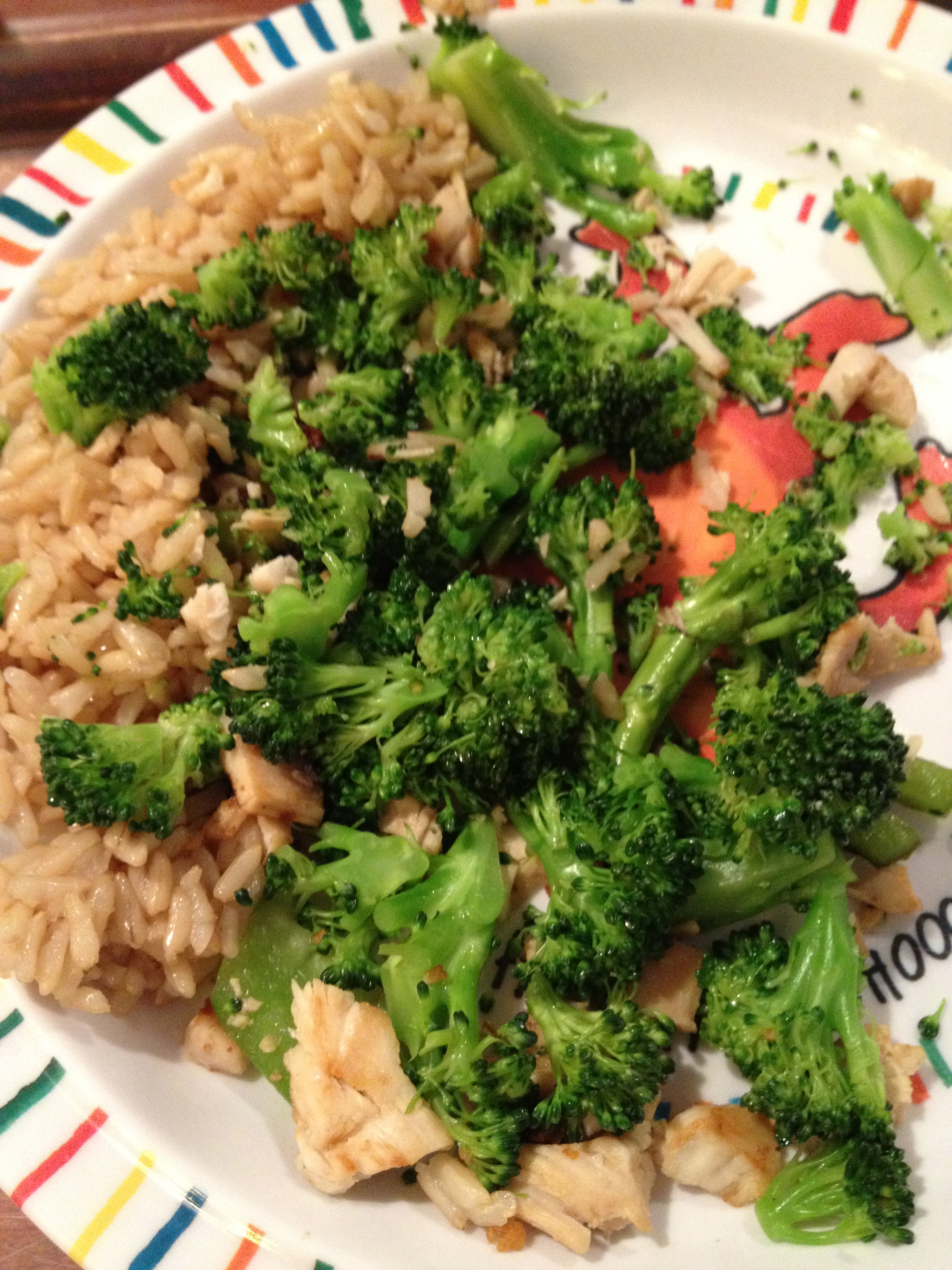
I had some left over chicken in the fridge and some fresh broccoli from our box.

  1. I steamed the broccoli for less than 5 minutes so it could have a nice crunch.
  2. On a pan, I heated a little coconut oil.
  3. I chopped a little bit of ginger and green pepper and tossed it in the pan.
  4. Then I tossed in the leftover chicken which I chopped up into tiny pieces.
  5. I sauteed the ginger, green peppers and chicken with a splash of liquid aminos
  6. I heated up a packet of whole grain brown basmati rice
  7. And I served.

The meal came out delicious and the boys loved it. I noticed as I was feeding Justin that the meal was a little dry so I grabbed my olive oil spritzer and sprayed a little olive oil to moisten it up and add some good fat to their meal.

On the items I used:

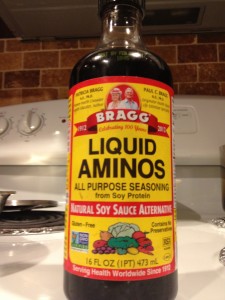
Liquid Aminos is a little gem to have at the house. It is a healthy alternative to soy sauce and it has 16 amino acids. The ingredients are Vegetable Protein from Soybeans and Purified Water. I use it in small quantities because I think it has a powerful taste but it really adds a nice touch to stir fries, or when you want to revive leftover grilled chicken or something like that.

: Healthy Soy Sauce Alternative

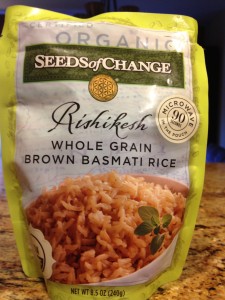
I found this rice at Publix and tried it yesterday for the first time. It is a Whole Grain Brown Basmati Rice. Orlando and I don’t eat rice regularly but my doctor did tell me that kids need more whole grains than adults so I want to make sure to give them a balanced meal. I  thought this was great because it was microwaveable and has very low sodium 10mg. I tried it and will confess that its a little flavorless, but with the combination of the liquid amino chicken and vegetables and a spritz of olive oil, it was delicious.

We took this genius idea from Alton Brown’s Good Eats episodes. Olive oil is a tough one because its easy to drizzle too much on the plate. I bought this spray bottle at bed bath and beyond for less than $2.00 and it lets us control how much olive oil we want to put in our meals. In yesterday’s case, I only wanted a spray or two just to add a little moisture to the meal and it worked like a charm!


Beet Soup – One of our family favorites

I grew up in a Cuban family, and we all know that vegetables are not popular in a typical Cuban meal. In fact, if you ask many Cubans whether or not they eat vegetables, they will likely respond…well, I eat corn!!!!!
 
In my case,  a typical dinner for me was rice, black beans, and ______ (fill in the blank, picadillo, steak, fricassee, etc.) But every once in a while, I must confess that my mother threw in some vegetables for us. Now to her defense, this was before the age of google and she really was not fluent in the health movements we know today. So just the fact that she attempted to incorporate some veggies in our meal merits a little credit, coming from her cultural background. One of the vegetables I grew up eating on occasion were canned red beets. As a child, I looooooved those red beets that my mom would serve. In my ignorance, I didn’t realize that they could be purchased in the produce section of the supermarket because I had only been exposed to the canned ones.
 
My love affair with red beets disappeared once I went to college and I never really ate canned red beets again. And then one day, I picked up my box of shares from Annie’s Organic Club and there they were, red beets…. the actual vegetable. Excited, I told Orlando that I loved red beets as a child and that we should make them.
 
Orlando made a soup which instantly became a family favorite in our home, and because we had extra beets, he roasted the rest of them and we had those on a different day. Both the roasted beets, and the soup are delicious and so healthy. We hope you enjoy this recipe.
 
Beet and Garlic Soup: (We got this recipe from the Whole Living Cleanse article we spoke about in a prior post. )
 
Makes 4 cups

Ingredients

  • 6 medium beets
  • 2 tablespoons olive oil, plus more for drizzling
  • 8 unpeeled garlic cloves
  • 1 large leek, thinly sliced
  • 1 teaspoon fresh thyme leaves
  • 1 bay leaf
  • Coarse salt and pepper
  • 2 tablespoons lemon juice
  • 4 cups of vegetable stock

Directions

  1. Heat oven to 400 degrees. Drizzle beets with olive oil and roast in parchment-lined foil until tender, about 1 hour. Meanwhile, drizzle garlic cloves with oil and roast in separate foil packet, about 30 minutes (add the garlic after the beets have roasted for 30 minutes and let them both cook for another 30). Unwrap beets, let cool, peel, and quarter. Squeeze garlic from skin. Set aside. (TIP: Orlando usually roasts an entire head of garlic and keeps the leftovers in the fridge for other recipes we make that week.)
  2. Heat 2 tablespoons olive oil in a pot over medium heat. Add leek and cook, stirring, until tender, 6 to 8 minutes. Add beets and garlic, thyme, bay leaf, and 4 cups vegetable stock. Season with salt and pepper.
  3. Bring to a boil, then reduce heat and simmer, 5 minutes. Discard bay leaf. Let cool slightly, then puree in a blender until smooth. Stir in lemon juice and adjust seasoning to taste.

 A NOTE ON CANNED RED BEETS:  After we had this delicious soup, I told Orlando to go to the store and buy the canned red beets. Rarely do we find a vegetable that we like in  a can and I thought it would be good to keep it at the house for when we were in a pinch with the boys and needed a quick veggie. I was DEVASTATED to find out that canned red beets have added high fructose corn syrup. Can you believe that? A vegetable that is naturally sweet! These companies get a perfectly healthy vegetable that is intended to detoxify your body and use it to attack your liver instead. It is offensive and wrong and shows a huge problem with the food industry in this country. I didn’t even bother to check the ingredients of the can when we bought it because I would have never even dreamed that it would have added sugar. I didn’t remember the canned version being any sweeter than what the roasted beet tasted like now. So I served it and took an excited bite, when my taste buds screeched and said….whoa, these beets are tooooo sweet. That’s when I looked at the back of the can and realized that I was having a healthy vegetable soaking in high fructose corn syrup. It is safe to say, we do not have canned red beets at home any more.

IN CASE YOU’RE  NOT CONVINCED TO TRY RED BEETS. PLEASE TAKE A MINUTE TO READ ITS HEALTH BENEFITS:

  • Beets are a unique source of phytonutrients called betalains. Betanin and vulgaxanthin are the two best-studied betalains from beets, and both have been shown to provide antioxidant, anti-inflammatory, and detoxification support. The detox support provided by betalains includes support of some especially important Phase 2 detox steps involving glutathione. Although you can see these betalain pigments in other foods (like the stems of chard or rhubarb), the concentration of betalains in the peel and flesh of beets gives you an unexpectedly great opportunity for these health benefits.
  • Unlike some other food pigments, betalains undergo very steady loss from food as the length of cooking time is increased. For example, one recent study has shown the red betalain pigments in beets to be far less heat stable than red anthocyanin pigments in red cabbage. The difference between 15 minutes of steaming versus 25 minutes of steaming, or 60 minutes of roasting versus 90 minutes of roasting can be significant in terms of betalain damage. For these reasons, we recommend that you keep beet steaming times to 15 minutes or less, and roasting times under an hour.
  • An estimated 10-15% of all U.S. adults experience beeturia (a reddening of the urine) after consumption of beets in everyday amounts. While this phenomenon is not considered harmful in and of itself, it may be a possible indicator of the need for healthcare guidance in one particular set of circumstances involving problems with iron metabolism. Individuals with iron deficiency, iron excess, or specific problems with iron metabolism are much more likely to experience beeturia than individuals with healthy iron metabolism. For this reason, if you experience beeturia and have any reason to suspect iron-related problems, we recommend a healthcare consult to follow up on possible issues related to iron status.
  • In recent lab studies on human tumor cells, betanin pigments from beets have been shown to lessen tumor cell growth through a number of mechanisms, including inhibition of pro-inflammatory enzymes (specifically, cyclooxygenase enzymes). The tumor cell types tested in these studies include tumor cells from colon, stomach, nerve, lung, breast, prostate and testicular tissue. While lab studies by themselves are not proof of beets’ anti-cancer benefits, the results of these studies are encouraging researchers to look more closely than ever at the value of betanins and other betalains in beets for both prevention and treatment of certain cancer types. http://www.whfoods.com/genpage.php?tname=foodspice&dbid=49